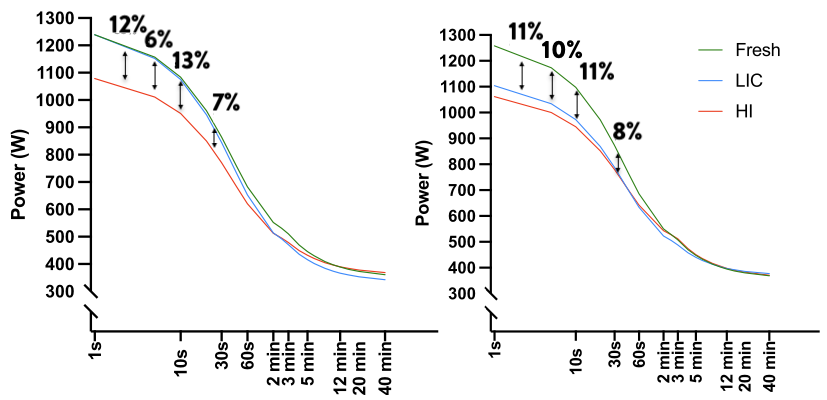
Jekyll2024-10-19T04:09:37-07:00https://andreazignoli.github.io/feed.xmlPersonal websiteM. Eng., PhDAndrea Zignoliandrea.zignoli@unitn.itA model that can evaluate the maximal mean power **during** exercise?2024-03-21T00:00:00-07:002024-03-21T00:00:00-07:00https://andreazignoli.github.io/blog-post-8Cover Figure: Downward shifts in the power profile were expected and have been documented in fatiguing conditions (adapted from Spragg et al. 2023). Is it possible at all to receive this info *during* exercise?.
An inspirational paper
In the last few days, a new-ish published paper (Spragg et al. 2023) caught my attention. The paper has been written by an esteemed research unit that includes eminent researchers in the field of endurance sports and power profiling in cycling. This study investigated the impact of prior work intensity on the power-duration relationship in professional cyclists. Fourteen cyclists underwent three power profile tests: one in a fresh state and two after different fatiguing protocols. The results suggest that the intensity of prior work, particularly for shorter-duration efforts, plays a crucial role in the downward shift of the power-duration relationship, highlighting the importance of considering work intensity beyond just total workload.
The Cover Figure is adapted from the original study, and highlights the meaning behind the downward shift in the maximal mean power values due to the “fatiguing” protocols. (for more discussion on my use of the word, “fatigue”, read below).
The main reason why I felt attracted by this publication is that it aligns perfectly, in my opinion, with the concept behind the Athletica Workout Reserve. Very briefly, the Athletica Workout Reserve does exactly that: it monitors the oscillations of an athlete’s maximal mean power during exercise.
A very simple idea
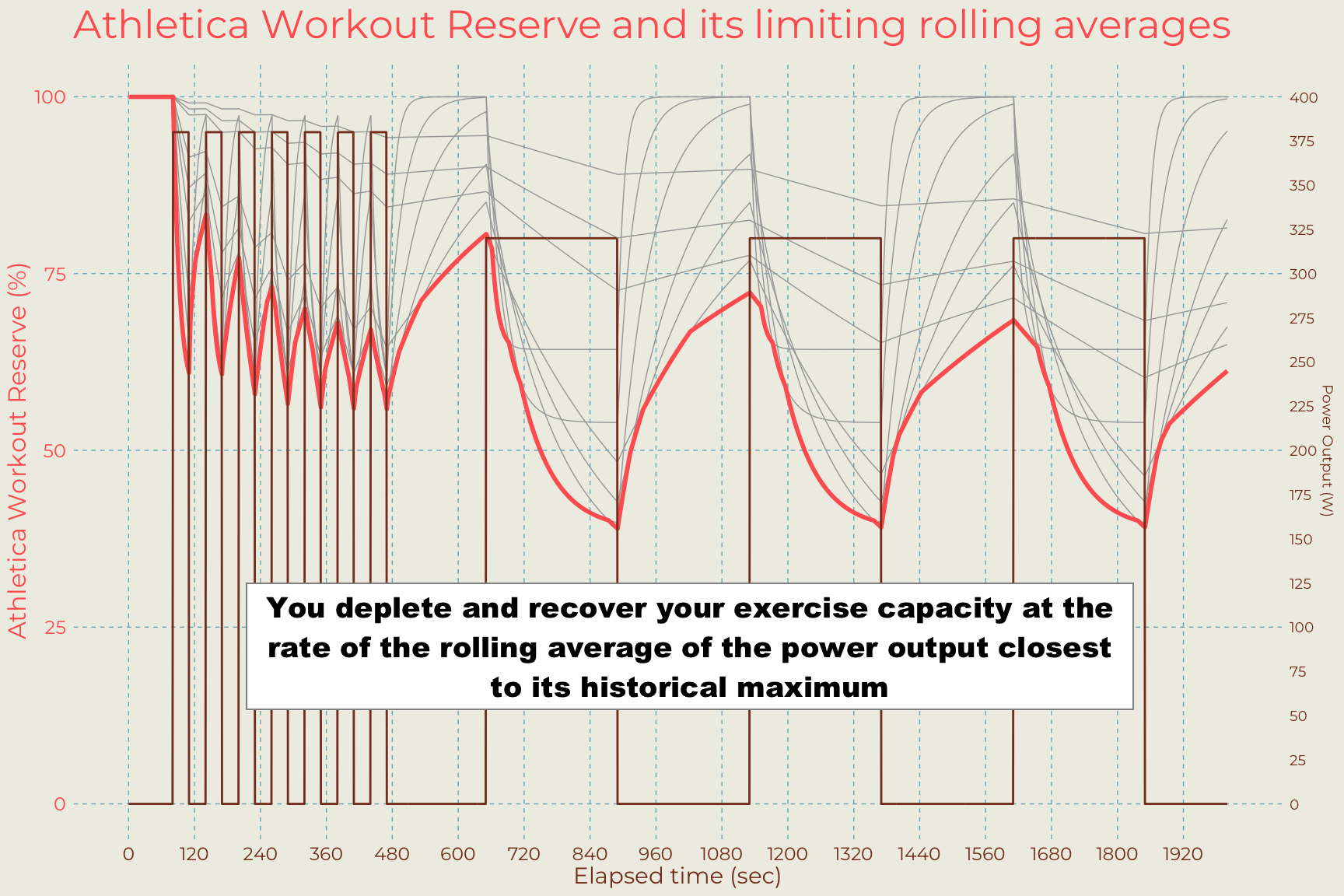
The Athletica Workout Reserve is based on a very (very) simple idea. Actually, it might well represent the simplest model for exercise capacity that I am aware of. As written in Figure 2, if the minimal distance between the exercising maximal mean power and the historical maximal mean power can be used as a proxy for exercise capacity, then we can say that: the exercise capacity is depleted and recovered at the pace of the rolling average of the power output that is closest to its historical maximum. It might sound complicated, but this is the shortest and most generic version I could conceive. When the WR is 0% it means that there is a rolling average reaching the 100% of its historical maximum. That’s it, nothing more nothing less.
Figure 2) Example of the fluctuations in Workout Reserve during a simulated HIT session. The minimum Workout Reserve (WR) is depicted in red. The red line follows the rolling average that is closest to its historical maximum. The thin gray lines are the rolling averages that are not limiting the exercise. In this example the minimum WR reaches 50%, which means that the rolling average closest to its maximum is at 50% of this maximum. Eventually, if the WR is 0%, it means that there is a rolling average reaching 100% of its historical maximum. Which rolling average exaclty? This information can also be retrieved with the WR.
It must be noted that this concept can be applied broadly to different endurance activities, not only those that involve power measurements such as cycling and rowing. Indeed, in cycling, the power output is directly related to exercise intensity, so for running we should consider the running speed. The same concept is still valid for running speed profiles and, perhaps in the future, running power profiles.
A real-time Garmin application
At Athletica there is no shortage of brain power. I was lucky enough to have a fan in Paul, and he involved Phil in the implementation of the WR concept on the Garmin devices. The app is free to use, but you need a subscription to Athletica, which is also free for a trial.
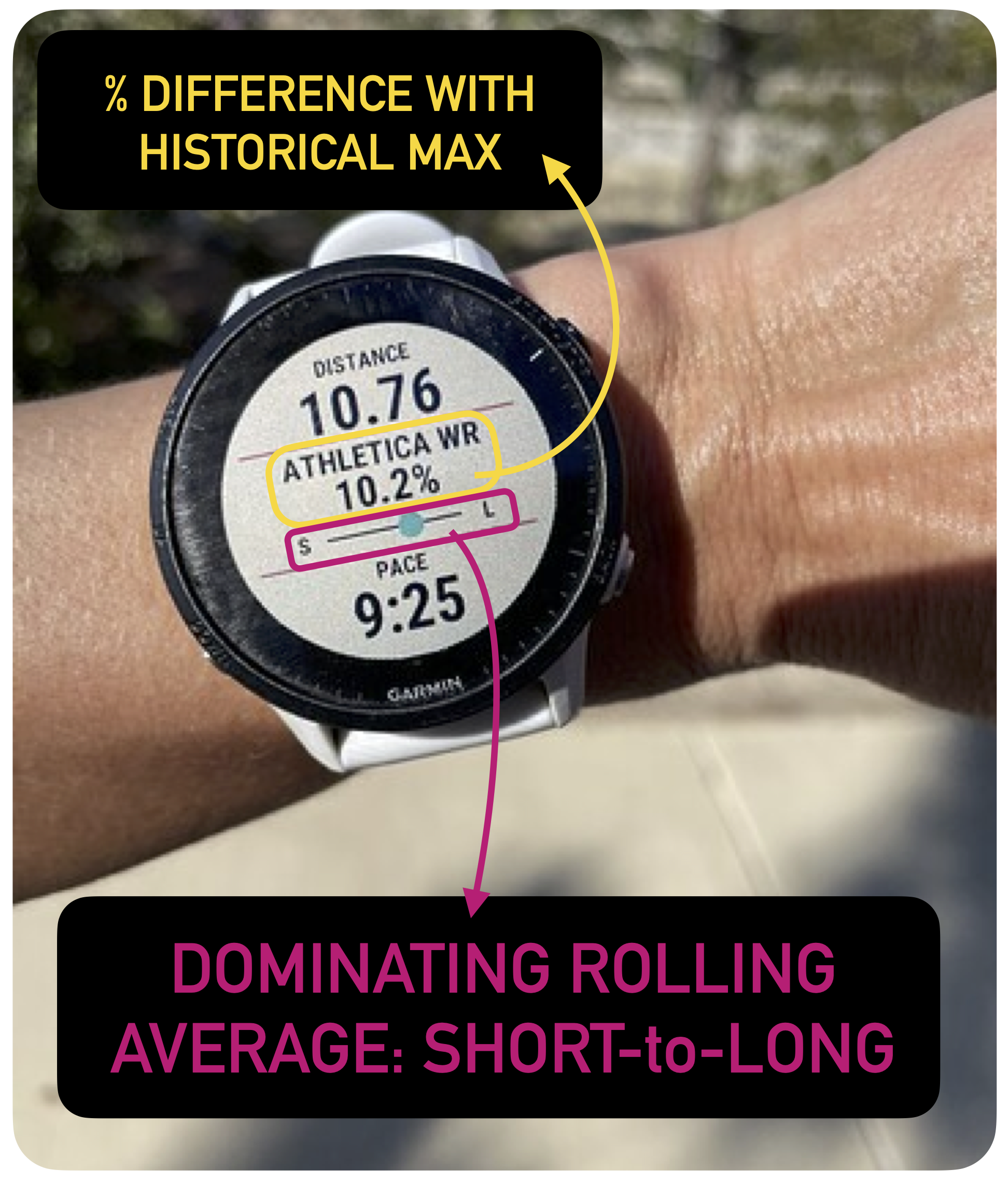
In Figure 3 a picture taken on a Garmin running the App is presented. As you can notice, the value of the minimum WR is presented in %, along with a slider (available in “advanced” display modality). The % WR tells you how far you are from one of your maximal mean power points, whilst the slider tells you whether these points are those closer to the short-time/high-intensity domain (“S”) or closer to the long-time/low-intensity domain (“L”). I find this pretty cool actually.
Figure 3) The meaning behind the numbers, in a snapshot taken during a training session (photo credits @TiredMomRuns).
Is an athlete always exhausted at WR=0%?
No! Not necessarily. Two perspectives.
1) It might happen that the WR can fall below 0%, which means that a new record is established and that they have set a new maximal mean power for a specific time/intensity-domain. In this case, there is only a simple explanation: the reached maximal mean power during exercise is >100% of the previously known maximal mean power. It’s no secret that the maximal mean power concept relies on maximum efforts to be included in the profile. And, by the way, this is true for each and every forecast model that makes use of historical data to make predictions and inferences about the reality.
2) An athlete can be exhausted before reaching the 100% of their maximal mean power. We should bear in mind that the maximal mean power is populated with the best data we have in the recent history of training/racing. E.g., in Spragg et al 2023, the authors talk about a “fresh” profile, and they adopted a technique that is not exactly the maximal mean profile, but this should not have a huge impact on the conclusions of this post. The WR=0% represents a limit, it’s not a sine qua non condition for exhaustion. Exhaustion can occur before that point. This is due to the fact that unfavourable conditions such as heat or injury might impair the ability of an athlete to push at their maximum limits for that specific time/intensity-domain.
Is the connection with Athletica is necessary?
The main reasons why the WR App needs Athletica is because Athletica can compute your power/speed profile in the way that can be digested by the WR algorithm. Thanks to the invisible monitoring system that Athletica has in place, if an historical maximal mean power is beaten (WR<0%), an athlete’s power/speed profile is automatically updated. Athletes can therefore leverage the internet connection of their Garmin devices to download the last speed/power profile available with their Athletica account before they start a new session/race.
Athletica needs at least 10 sessions to consider your speed/power profile “realiable”. Therefore, if you are starting on a free trial and you want ot test WR from day 0, you might need to use the data already available on your Garmin Connect and/or Strava (either one of these connections is required anyway to let you upload data on Athletica). After a session is completed, the WR is displayed in the data “Analysis” tab of the session. However, the Garmin fit file will be storing the WR values, so they can be visualised with other interfaces.
How can I use WR in training and racing?
We still have limited experience on how to use the WR during exercise and racing. Some examples have been collected in a blog post. It is all speculative at the moment, and very experimental.
Whether this tool can be used to assess an athlete’s “fatiguability” is an open question. What is also unknown is whether WR can be somehow associated with rating of perceived exertion (RPE). It is natural to think that the closer an athlete is to their maximum, the higher the RPE. Also, very brief maximal exercise might elevate RPE for shorter amount of time compared to long duration efforts. In these terms, it sounds like the dynamics of RPE might be associated with WR (again, all speculative at the moment).
The great advantages of WR, is that: 1) this can be assessed in real-time, and 2) the specific time/intensity domain that leads to exhausiton can be revealed.
All-in-all the WR holds some promise and, in my view, it aligns well with the rising concepts of “durability” and “moving thresholds”. Indeed, for WR, there are no thresholds at all, just upper limits.
Note about “fatigue”
The reason I used quotes for the word “fatigue” is because, to my knowledge, the downward shifts in maximum mean power have not yet been associated with standard markers of fatigue, such as maximal voluntary contraction, etc. I maintained the terminology adopted in the paper by Spragg et al. to ensure consistency.
]]>Andrea Zignoliandrea.zignoli@unitn.itOf eagels, sunflowers, and cycling trajectories2023-11-23T00:00:00-08:002023-11-23T00:00:00-08:00https://andreazignoli.github.io/blog-post-7Fascinating trajectories in nature. An eagle soaring over a prey, the seeds of a sunflower, and a group of cyclists cornerning at the 2024 Milano-Sanremo race.
Trajectories in nature
What does an eagle that hunts a prey have in common with a sunflower? 🦅 🌻 Well, apparently, both the trajectory of the eagle and the disposition of the seeds of the sunflower share the same mathematical structure: a spiral following a Fibonacci pattern.
In nature, spirals come in many forms 🍭🐚 … but there isn’t a clear classification for all of them. While some, like fern buds, are easily recognized as spirals, others aren’t as obvious. What is both fascinating and evident, is that nature loves smooth transitions and graceful curves, and hates discontinuities, especially in movements. In other words: Natura non facit saltus (Carl Linnaeus, Philosophia Botanica - Chapt. 27).
Interestingly, humans have conceived and created spiral shapes that don’t exist in nature. One such spiral is called the clothoid, and indeed isn’t found in nature. In the present blog post, we introduce and discuss a fascinating question: is there a case to be made that cyclists trace clothoids while descending?
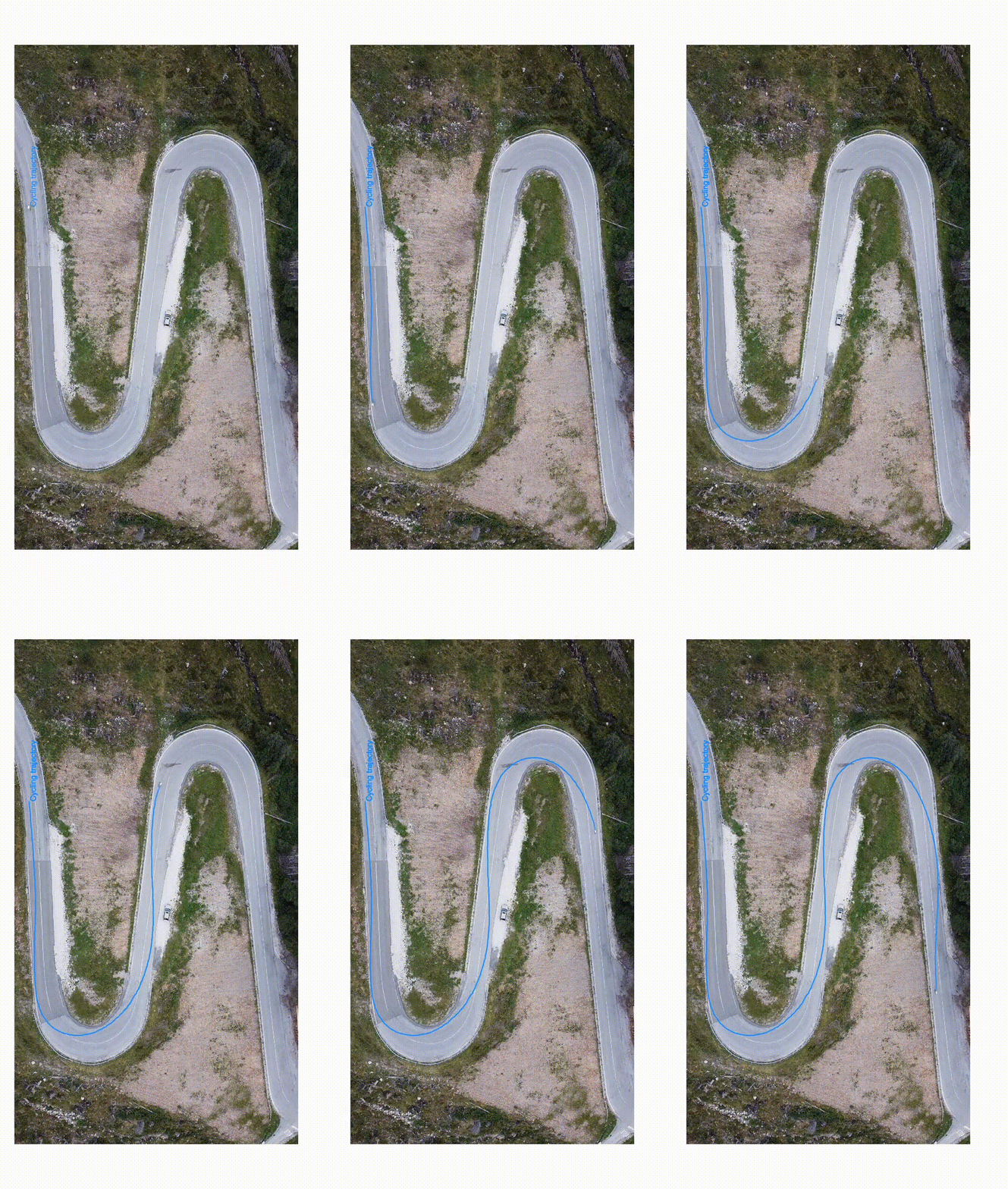
The trajectory of a cyclist on a descent, as captured with a drone during a (scientific study)[https://link.springer.com/article/10.1007/s12283-022-00386-1].
A famous spiral in road and rail engineering
To travel along a circular path, an object needs to be subject to a centripetal acceleration (for example: the Moon circles around the Earth because of gravity; a car turns its front wheels inward to generate a centripetal force).
If a vehicle traveling on a straight path were to suddenly transition to a circular path, it would require centripetal acceleration suddenly switching at the tangent point from zero to the required value; this would be difficult to achieve. Think of a train instantly moving from straight line to turning position, and the train-cars actually executing it, putting mechanical stress on the train’s parts, and causing much discomfort to the passengers.
In the past, on early railroads, this instant application of lateral forces was not an issue since low speeds and wide-radius curves were employed (lateral forces on the passengers and the lateral sway was small and tolerable). As speeds of rail vehicles increased over the years, it became obvious that an easement is necessary, so that the centripetal acceleration increases gently (e.g. linearly) with the traveled distance. Given the expression of centripetal acceleration:
\[a_c=v^2/r\]
the obvious solution is to provide an easement curve whose curvature:
\[k=1/R\]
increases linearly with the traveled distance. Indeed, a spiral where the curvature increases linearly with the arc length is a clothoid, or a Euler’s spiral. Nowadays, drawing clothoids instead of circles is a design choice made in road and rail engineering, particularly in designing curves and transitions. Indeed, the reason behind using clothoids comes down to providing a smooth transition between straight paths and circular curves.
Of cycling and racing lines
Human movement is all about optimization, and involves finding the most “convenient” way to plan and execute movement. In the context of movement, the human body possesses a high degree of redundancy. For instance: 1) there is an incredible number of joints in the human body, and the same end-point might be reached with a different combination of angular joint angles; 2) multiple motoneurons activate a single muscle, and multiple muscles can actuate a single articular joint, so muscle recruitment must consider the “biomechanical” convenience of the individual muscles (fiber typology, moment arm, position, speed of contraction, etc.); 3) on a higher level, a person might travel from point A to point B using different trajectories or a different distribution of intensity along the course (i.e., different pacing strategies). The list of examples could continue indefinitely.
Is there a better image to explain how humans are moving around?
But what does “convenient” really mean? It could encompass different interpretations depending on the context. Generally, it’s believed that humans seek to minimize energy consumption, perceived effort, or strike a balance between perceived and expected effort. The choices humans make during movement, whether it’s reaching for a pen or completing a cycling trajectory, may involve a mix of conscious and unconscious factors. The true optimization goal of the human body remains a topic of debate and one of the most intriguing challenges in motor control studies.
Let’s focus on cycling for now, considering an individual time trial as an example. In a race, riders strive to optimize their arrival time. However, not everyone competes with the intention to win or goes full throttle due to strategic considerations such as the general classification, team responsibilities, or a lack of interest in stage victory. Hence, we might ponder: is there a common factor that applies to everyone?
One common aspect often under scrutiny is the smoothness of the trajectory or its counterpart, the concept of jerk. Jerk, derived from acceleration, signifies the acceleration variation and can be calculated across various parameters such as body joint accelerations, torques, power output, and more. Cyclists executing abrupt movements tend to struggle with cornering effectively. Factors like rough road surfaces, wet wheel rims, sudden steering adjustments, and excessive reaction to bumps disrupt the fluidity of movements and cornering. By seeking seamless transitions between straight paths and curved trajectories, cyclists aim to minimise both performance time and jerk at the same time. This strategy promises the best overall performance, achieving a harmonious equilibrium among multiple factors, including risk and reward.
In discussions about racing lines, therefore, it’s reasonable to consider that experienced cyclists might trace clothoids along their routes, especially when transitioning between a straight and a circular path. Given that the road available has its own space constraints, we can say, more accurately, that cyclists follow splines of clothoids.
"The racing line, not only a matter of final time minimisation, but also comfort and risk. Clothoids are often used because they provide a gradual change in curvature, which helps minimize discomfort for the driver and reduce wear and tear on vehicles. Photo credits: Brian Snelson from Hockley, Essex, England, CC BY 2.0 <https://creativecommons.org/licenses/by/2.0>, via Wikimedia Commons"
Just a coincidence?
There seems to be something profound that links curves and trajectories in nature, not just a coincidence. From the arc of an eagle in flight to the spiral of a sunflower, these natural patterns hint at a fundamental relationship between form and function. Through the neverending renegotiation of tiny adjustments, human movements evolve and patterns such as cycling trajectories emerge. Those choices that promise greater success are embraced, learned, encoded in our neural circuitry, and eventually revisited.
Human movement embodies an endless journey of exploration and discovery, delving into the depths of our existence. Yet, along this journey, some truths emerge as fundamental pillars of our ability to move: the intrinsic essence of movement itself is deeply rooted in the fabric of nature.
“OK, Andrea, but please what do I need to know this for?” Well, let’s assume you are collecting cycling GPS positions every second, how do you connect those points? Now, you should already now what I would suggest. Your best bet is to take the GPS points and fit them with a spline of clothoids.
]]>Andrea Zignoliandrea.zignoli@unitn.itRisk and rewards in road cycling fast descents2022-05-27T00:00:00-07:002022-05-27T00:00:00-07:00https://andreazignoli.github.io/blog-post-6Photo by Unsplash
— William Shakespeare Romeo e Juliet - Act III, Scene III ]]>Andrea Zignoliandrea.zignoli@unitn.itAI applied to cardiopulmonary exercise test data2022-03-03T00:00:00-08:002022-03-03T00:00:00-08:00https://andreazignoli.github.io/blog-post-5— Inspired by Lynda Chin, from Eric Topol's book Deep Medicine Chapt. 2
The chasm between AI and clinical implementation
The number of applications of AI to health care and health-related fields has been exponentially growing in the last decade. However, of all the algorithms developed, a minor fraction of them is actually implemented in the clinical practice. This gap is also known as AI chasm. AI chasm is what separates a technology available to a very advanced readiness level (e.g. a lab prototype or a proof-of-concept) from a technology which is deployed and put into production. In this brief contribution, I would like specifically to discuss about the AI chasm in the context of cardiopulmonary exercising test data interpretation.
Why is this chasm occurring
Explanatory power
A new algorithm might never be used in the real practice in spite of scientific studies proving its accuracy. The main reasons is that accuracy is not the only objective that an AI system should have: intelligibility is another very important one. It looks like clinicians are reluctant when it comes to try new algorithms that cannot provide explanations for the results.
Arguably, models can vary in complexity and structure. Multi-linear models are a prominent example in statistics, where the results of a fitting process can be used to understand the relative importance of all the input variables and how they interact to make the predictions. These models are relatively simple, as they include a limited number of parameters for every single input variable. On the other side of the spectrum, deep learning techniques are widely adopted to extract patterns and features from complex data arrangements, but they might easily include millions of parameters. Are we able to deconstruct and ultimately understand all the patterns the model has learnt? Can these models tell us something about the underlying physiological process we are trying to create a model for?
The number of parameters in a model per-se does not indicate good or bad explanatory ability. In the case of deep learning, there are models that can show layer by layer what features have been isolated, and this helps understanding the defining characteristics of the input data. This is common in image or shape isolation/recognition problems, but it is far more complex when multivariate time-series data are considered.
Transparency and adaptability
Deconstructing a model and translate in plain language the characteristics of the extracted features is problematic. Indeed, most of the models are very good in making predictions, but very inefficient when it comes to provide explanations. This is not the only reason why the AI chasm can occur. Other important elements in the diffusion of a new model are transparency and adaptability. On one hand, transparency is about the data used to train the model: is that representative of the population the clinician is targeting? Open and transparent information about the dataset used to train the model could give clinicians more confidence when using the model in their unique day-to-day practice. On the other hand, adaptability is about the degree at which a given model can be personalized by the end-user. This personalization can be in terms of data but also in terms of interpretations and perhaps beliefs.
Cognitive load
Importantly, some AI model implementations suffer from excessive false alarms and complex explanatory visualizations. There is no doubt that AI models that put additional cognitive load (i.e., the mental effort required to perform a task) on the clinicians will always find a very hard way to production. It is not a secret that cognitive overload in clinical practice is highly associated with bad health care services. There is no need for an AI that can provide assistance with data interpretation at the cost of an overloaded or overly stressed clinician. Any AI system that can actually decrease the cognitive load of a clinician should be prioritized.
The cardiopulmonary exercise test challenge
Threshold detection: cognitive or merely computational?
The cardiopulmonary exercise test is the gold-standard for the evaluation of an individual aerobic fitness. Data consist in breath-by-breath values of different ventilatory variables such as: oxygen uptake ($VO_2$), exhaled carbon dioxide ($VCO_2$), and ventilation ($VE$). Clinicians interpret the data with knowledge, experience and beliefs. Interpreting the result of a test can sometimes take considerable cognitive toll. I believe, however, that there are instances where cognitive process can be merely considered computational, and this is the example of ventilatory threshold detection. This task is often times only a matter of detecting braking points and changing patterns in ventilatory variables, or at least this is the way it is presented in the scientific literature on the topic. It is undeniable that, in many cases, a human does not need to possess a profound knowledge about physiology to detect breaking points in ventilatory variables. This is the main reason why automatic methods for ventilatory threshold detection have been developed in the last four decades. These methodologies might or might not have explanatory power.
Simple models: explanatory but not accurate
Automatic methods which implement complex computations are poorly adopted in the clinical practice. On the contrary, a simple methodology developed in the 80s that implement linear regression is the most adopted algorithm. This model is thought to have physiological roots, as it looks specifically and intentionally for ventilatory thresholds in correspondence of breaking points in the $VCO_2$ vs $VO_2$ and $VE$ vs $VCO_2$ relationships. These breaking points underlie a more profound meaning at physiological level, as they can be considered hallmarks for exercise intensity domain boundaries. Applying this regression model to the clinical practice requires however deploying it on a processing unit. Once the model is finally tested, deployed, and put into production, can show limitations. Limitations are mostly due to unwanted portions of data polluting the input. It is soon pretty apparent that these models need some human cognitive load to select and pre-process only limited portions of the input data.
Easy implementation (both development and deployment)
CONS:
Pre-process is needed (manual work and cognitive toll)
Sensitive to signal-to-noise ratio
Deep learning models: accurate but not explanatory
Oxynet is a collection of deep learning algorithms conceived to decrease the cognitive load of the clinicians in the process of the cardiopulmonary test data. Oxynet explanatory power is still very low, but accuracy in ventilatory threshold determination is exceeding that of a human expert.
PRO:
Improved accuracy and robustness to the noise
Decreased cognitive toll (entirely automatic)
CONS:
Not explanatory
Complex implementation (especially deployment)
Final thoughts
In the search for the perfect algorithm, accuracy should not be the only goal. It is important to consider the ability to justify and explain the choices made by the model, and make the features extracted by the AI understandable for clinicians. Oxynet AI models have been conceived to alleviate the cognitive load associated with the determination of the ventilatory thresholds.
In the development of such models, however, we make the dangerous assumption that ventilatory threshold detection is a merely computational process that requires no prior knowledge about human physiology. In this specific sub-task of cardiopulmonary test data interpretation there is increasing evidence suggesting that clinicians might be better off with the aid of an AI which can take care of the computational aspects. The lack of explanatory power is paid off by an increased accuracy and a decreased cognitive load. This is why I believe that AI models like the one provided under Oxynet can help clinicians save time they can devote to tasks that only human can solve: in-person interaction, empathy and care.
Additional reading
Aristidou, Angela, Rajesh Jena, and Eric J. Topol. “Bridging the chasm between AI and clinical implementation.” The Lancet 399, no. 10325 (2022): 620.
Holm, Elizabeth A. “In defense of the black box.” Science 364, no. 6435 (2019): 26-27.
Ehrmann, Daniel E., Sara N. Gallant, Sujay Nagaraj, Sebastian D. Goodfellow, Danny Eytan, Anna Goldenberg, and Mjaye L. Mazwi. “Evaluating and reducing cognitive load should be a priority for machine learning in healthcare.” Nature Medicine (2022): 1-2.
Watson, David S., Jenny Krutzinna, Ian N. Bruce, Christopher EM Griffiths, Iain B. McInnes, Michael R. Barnes, and Luciano Floridi. “Clinical applications of machine learning algorithms: beyond the black box.” Bmj 364 (2019).
]]>Andrea Zignoliandrea.zignoli@unitn.itNotes on bike handling in road cycling2022-01-01T00:00:00-08:002022-01-01T00:00:00-08:00https://andreazignoli.github.io/blog-post-4Photo by Jack Delulio on Unsplash
Bike handling: what is it and why should anyone care?
I think that bike handling in road cycling is a challenging and fascinating research topic. Practitioners often talk about it, and there are interesting discussions on scientific papers and cycling blogs. However, I noticed that there can be at least two points of view, and mixing them up is not going to help, so let’s be sure we got ‘em first:
🚴 Sport science point of view: bike handling is synonym for technical skills, which translates in the ability of one-hand riding, effective and considerate obstacle avoidance, stoppie-wheelie tricks, navigating the pack, etc.
🚲🧑🤝🧑 Vehicle dynamics point of view: bike handling has more to do with the performance of the bike-rider coupling, i.e.: the ability that the riders have to consciously explore the limits of their bike.
The first point of view quickly translates in a safe ride, but it’s hard to find the association with cycling performance. For some, bike handling is about dealing with the unexpected, but for me it’s more about knowing very well what to expect. Hence, I support the second point of view, and I prefer not to mix bike handling with technical skills.
The possible reasons why bike handling is poorly studied might be:
It is not perceived as important as other physiological attributes
It is difficult to assess due to logistic and safety reasons
In this blog post I will try to give an idea about:
The impact that bike handling can have on the overall cycling performance
The tools we have to assess bike handling with ‘cost effective’ instrumentation
High-speeds = high-stakes
I am never scared when I descend. I feel like the master of the universe, even if it’s my mind playing tricks, because danger is all around.
— Romain Bardet for Rouleur, November 2020
As it often happens, the best riders can stand out from the group because their uncommon abilities. However, displaying uncommon bike handling abilities can be very dangerous. The limits of the bike-rider performance are dictated by physics, which places rigid constraints to the kind of accelerations (and decelerations) that the bike can sustain. High speeds are not dangerous per se, but because they can result in unsustainable accelerations. Uncommon bike handling abilities therefore require uncommon confidence and dexterity in a high-stake environment.
Both braking and cornering require different coordinated actions: pulling the brake levers, steering, and changing body position to lean into the corner. While braking can lead to strong longitudinal decelerations, cornering can lead to strong lateral accelerations. Forces needed to complete these actions are generated at the tire-road interface, and therefore depend upon the tire-road friction: the higher the friction, the higher the forces that the tires can sustain.
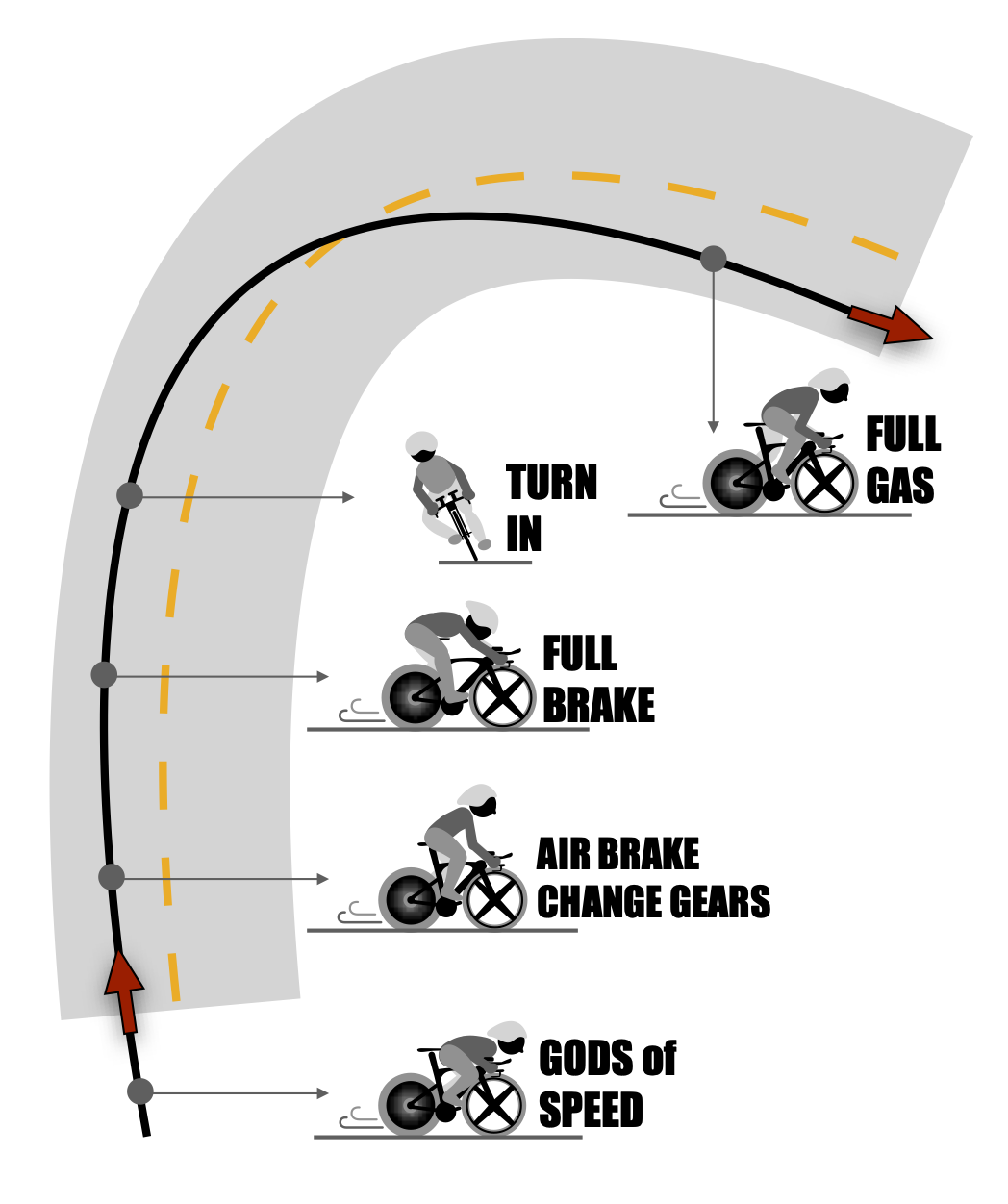
It’s easy to experience high-speeds while going downhill. In the next figure, the sequence of actions required during corner negotiation are represented for a generic downhill high-speed corner. As you can see, a change in the body position is required to use the body as an air brake, and then to negotiate the corner. Although the single actions might be the same, every rider can choose a particular timing and a particular strategy for the execution.
Sequence of actions while negotiating a high-speed corner in road cycling.
Bike handling and racing lines
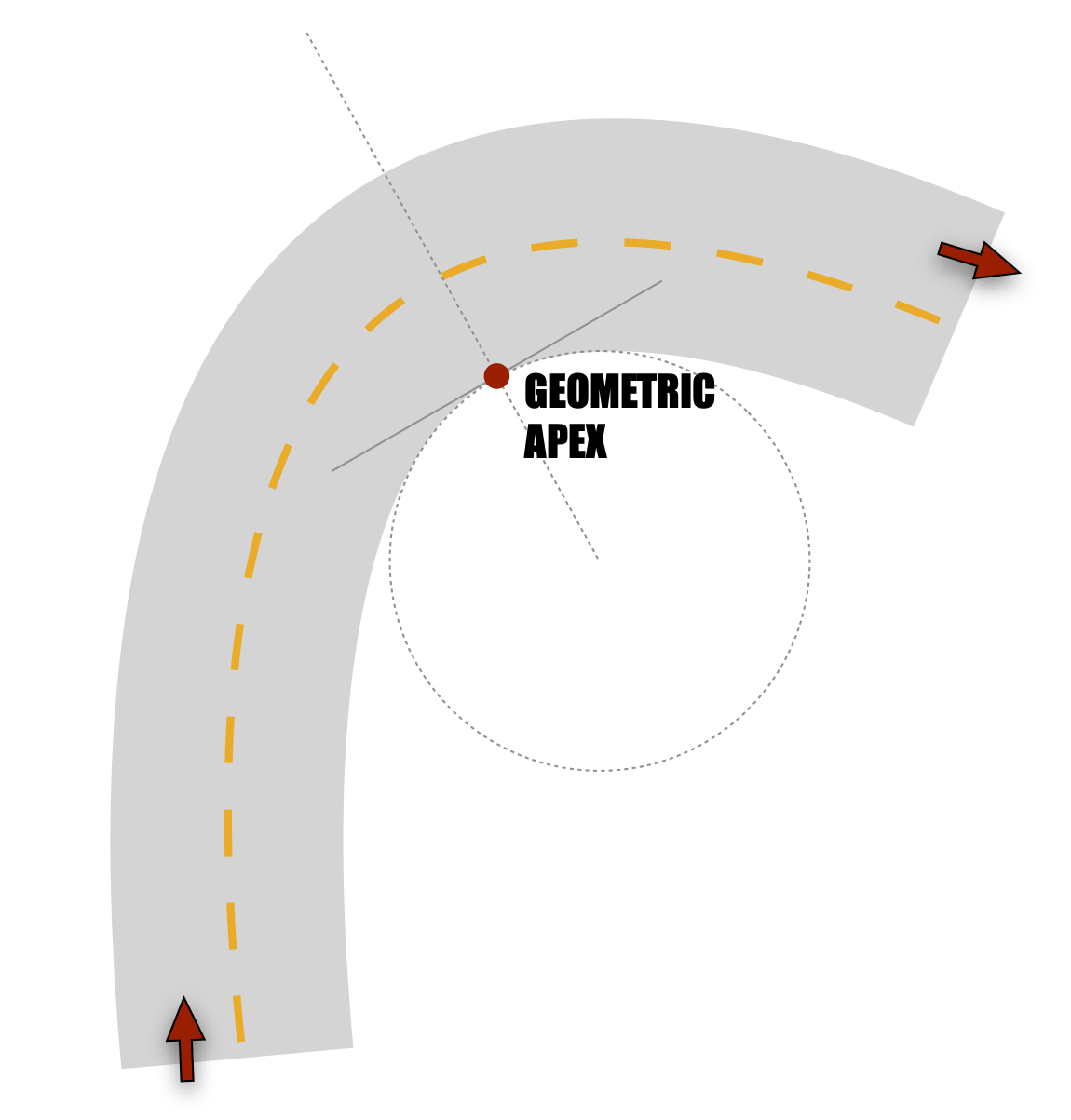
The trajectories that riders follow while they negotiate a corner are often called racing lines (a term inherited from motor sports). We can broadly classify two cornering strategies, which lead to different trajectories. Before getting to them, we need to define an important term: the apex. In the following picture you can see that the geometric apex is the point where the path has the minimum cornering radius.
The geometric apex.
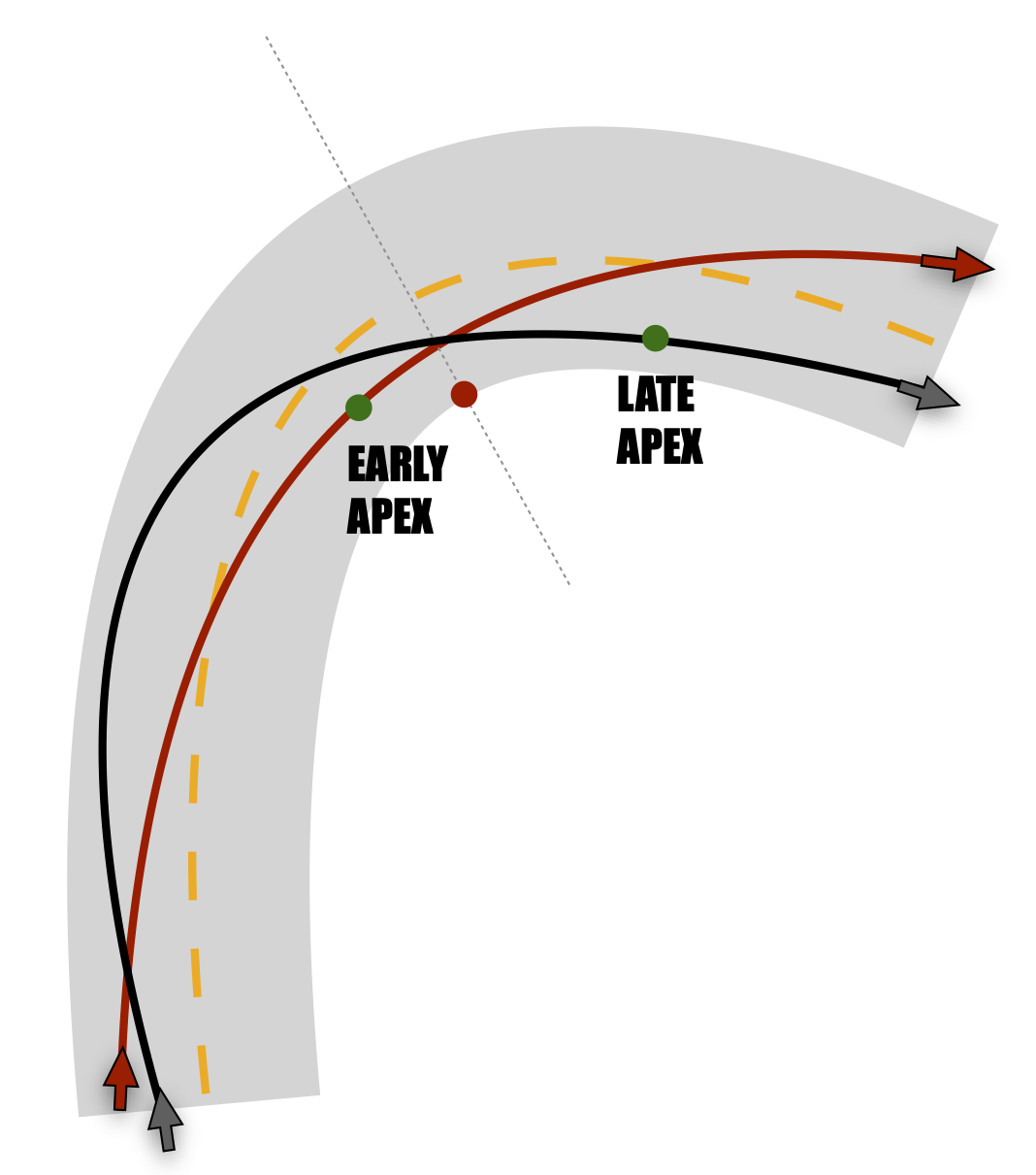
But we can also detect an apex on the racing line, which is usually defined as: ‘the point on the inside portion of a corner that a rider passes closest to’. A trajectory apex can be defined as being an earlier apex or later apex with reference to the geometric apex, and they are presented in the following figure.
Early VS late apex.
Late apex: The ‘late apex’ strategy is typically characterized by a hard braking action somehow separated from a following cornering action. The resulting racing line ensure a good line of sight and enough space for braking in emergency. This trajectories are usually characterized by low entry speeds and fast exit speeds.
Early apex: The ‘early apex’ strategy usually means less margin for error, as there is a very narrow line of sight and not a lot of space for adjusting the speed. A great advantage of this strategy is that, compared to the ‘late apex’, you can keep higher average speeds and you reduce the total travelled distance.
Is there an ‘optimal’ strategy?
This is the million dollar question. Albeit, by definition, there will always be an ‘optimal’ strategy (i.e., the one that can lead to the best time performance), there is no evidence that can support a single strategy consistently across every possible condition. I tried to collect here a number of possible variables that can impact the ‘optimal’ cornering strategy. In short, we can say that the ‘optimal’ strategy it’s individual and highly dependent on the race and environmental conditions.
🧑🤝🧑 Individuality: the ‘optimal’ strategy depends on the individual’s engine. A good sprinter with a lot of power available might prefer a ‘late apex’ strategy, because he/she can start delivering the power sooner.
☔ Environmental conditions:
Road conditions, with particular reference to the road surface and the resulting road-tire friction coefficient. In these regards, rain might be a game changer, especially in races with extended technical sections. A wet road of course is more slippery and hard braking actions and high lateral accelerations might not be sustainable.
Resistive forces are mainly represented here by the air resistive forces. They can have a lot of influence, but it depends upon they are due to front wind or tail wind. Front wind can help you brake more effectively before the corner and accelerate more efficiently after. Therefore, the front wind might support a ‘late apex’ strategy. On the other hand, tail wind can make it braking problematic, and accelerating after a corner might be even more demanding. Tail wind before the corner would suggest that an ‘early apex’ strategy is better.
Slope is another great game changer. If the descent is steep, it will be easy for you to accelerate after the corner, so therefore a ‘late apex’ strategy might be the best.
🔋 Race conditions:
Energy preservation strategies (i.e., the pacing strategies) that the riders are trying to implement can impact the ‘optimal’ strategy. It is known that strong accelerations that require massive power outputs are mainly supported by the anaerobic alactic metabolic pathway. These big bursts might not be ideal during long races, but they might be required during a breakaways. Again, higher average speeds and early apex strategy is advocated for those who don’t like to sprint out after the corners. Indeed, corners are often used by the riders to briefly recover and get ready for the next most demanding race sections.
What’s next? The position and direction of the next corner also affects the choice of the racing line. A fast exit speed might be useless if there is another corner that requires attention. Also, the infinite number of variations in road geometry and topology might require very different and hybrid approaches.
Road width is also of high importance, since it narrows down the space available on the road to brake and turn in. ‘Late apex’ strategy might be better suited for narrow roads, since it does not requires trajectories with large radii.
Evaluating bike handling
The gg diagram
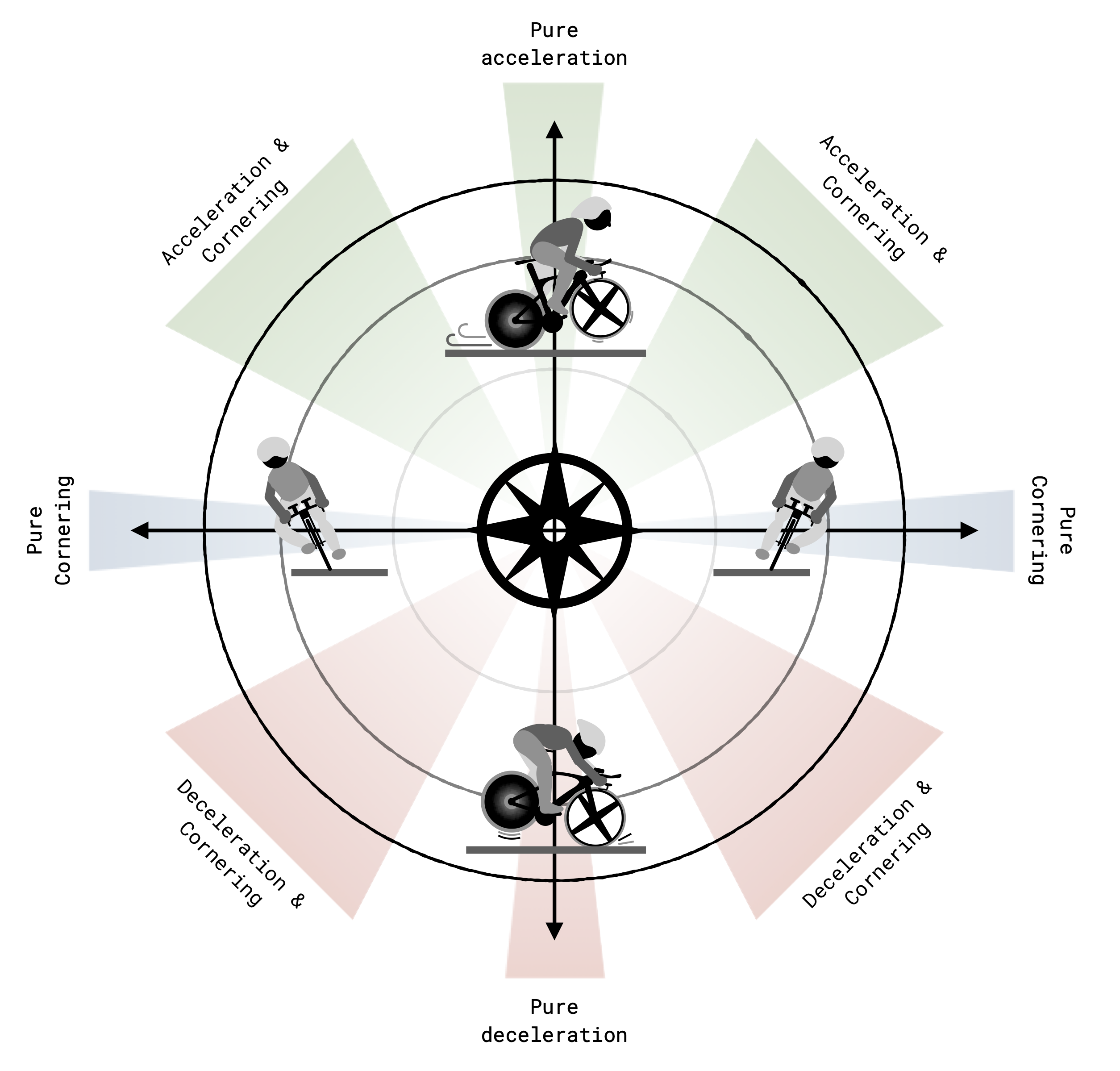
The gg diagram is widely used in motor racing to depict the accelerations of a vehicle in the road plane. In the following picture the structure of the gg diagram is presented. On the x-axis, lateral accelerations are reported. On the y-axis, longitudinal accelerations are reported. These accelerations are the highest during strong sprint efforts, rapid changes in road slope and hard braking.
The gg diagram.
How to read the gg diagram
🧭 If you look at the picture above, you’ll notice that a wind rose is included. Cardinal directions will be used here to better explain how to read the diagram.
East and West represent high lateral accelerations, typically high during high-speed corners. At North, we have strong accelerations, typically high when there is a sudden decrease in road slope or there is a strong sprinting action going on. At South, we have large decelerations, hence index of rapid increase in road slope or hard braking actions. Combinations are of course possible: at South/West and South/East we see combinations of lateral and negative accelerations (e.g., cornering and braking together), at North/West and North/East we see combinations of lateral and positive accelerations (e.g., cornering and accelerating together).
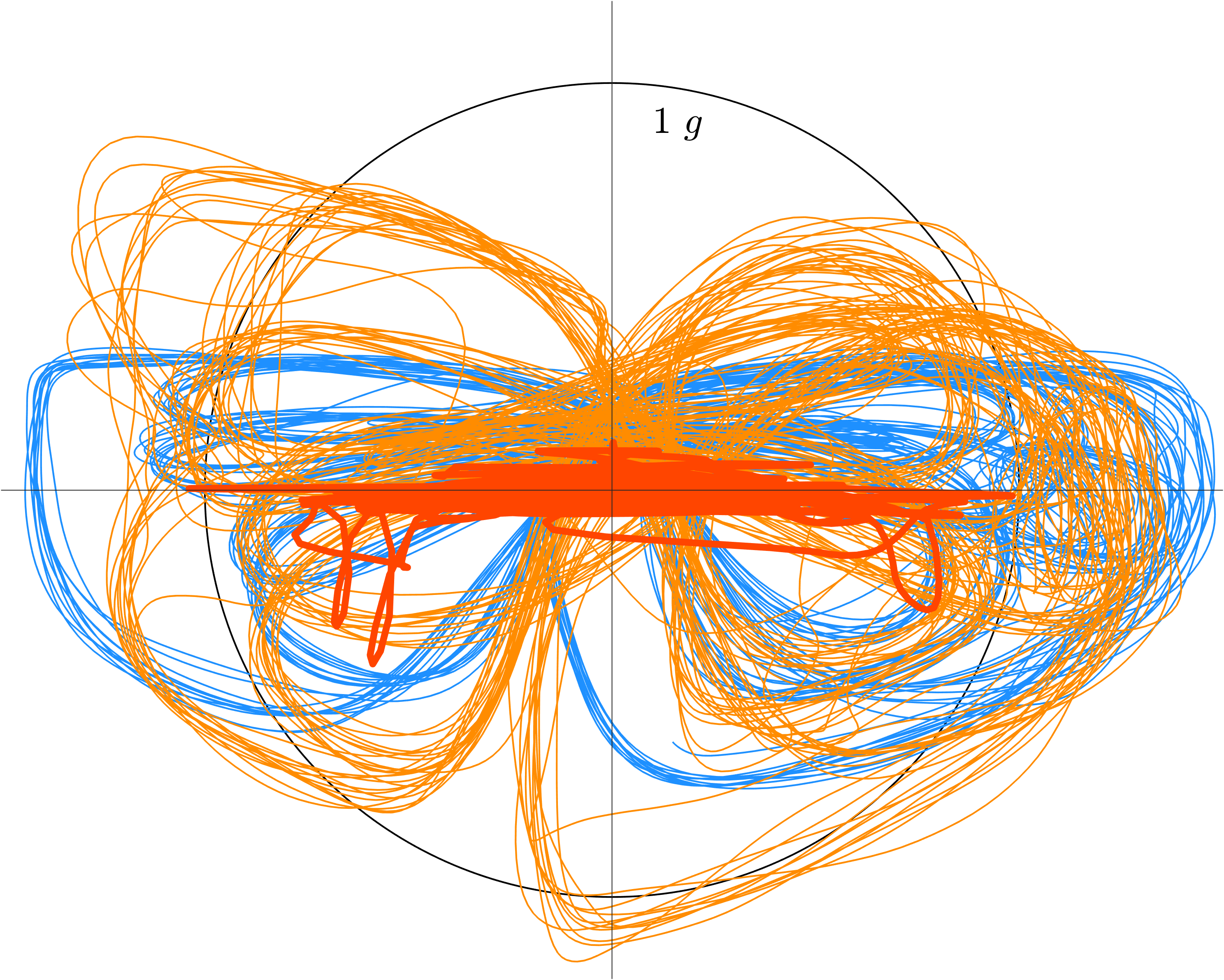
If we collect accelerations points and we draw them on the gg diagram we come up with a ☁️ of points, or a doodle, if you whish. This cloud can evolve into different shapes. For example, I provide an interesting comparison between bikes (bicycles) (red line), 125 cc motorcycles (blue line) and 1000 cc Super Bikes (yellow line). The motorcycling data has been kindly provided by Prof. F. Biral and they have been collected on the Mugello circuit during testing sessions. Cycling data has been provided by a professional cyclist at the Giro d’Italia 2020.
How an actual gg diagram looks like: 1000 cc bikes VS 125 cc bikes VS cyclist.
It is pretty apparent that motorcycles can produce higher accelerations in both longitudinal and lateral directions. As you can see, heavy 1000 cc bikes can sustain also strong combinations of lateral and longitudinal accelerations.
Practical considerations
Knowing what the ‘optimal’ trajectory might be and actually following it are two very different things. All the blog posts I read about the topic share one tip in common, and it sounds pretty much like: ‘you need to relax’! Yep, easy to say, but hard to execute. Descents are often cold, windy and repulsive: it’s no joke. Road surface is never perfect: pockmarked surfaces are a nightmare for cyclists! Putting in practice the guidelines it’s hard, if not impossible. However, visualization and mental preparation can be a very useful tools. Studying the topic can also help gaining confidence. In the end, bike handling is about knowing very well what is going to happen, and being able to leverage this knowledge to gain competitive advantage.
What about the equipment? Well, my current opinion is simple: the best equipment for getting the most out of your bike handling abilities is the one that will make you ride with more confidence. This is true for the bike frame, the wheels, the tires and the brakes. The unstable bike that will start wobbling at 60 kph will not give you the right confidence for extreme trajectories. Brakes are of key importance: I might say that disk brakes usually have a smoother response than rim brakes. So it’s not all about the braking power. I feel that many cyclists prefer the ‘late apex’ strategy in every condition, and this is because it requires a single strong braking action and no concomitant leaning/cornering action. To better explain this situation, I use again the gg diagram.
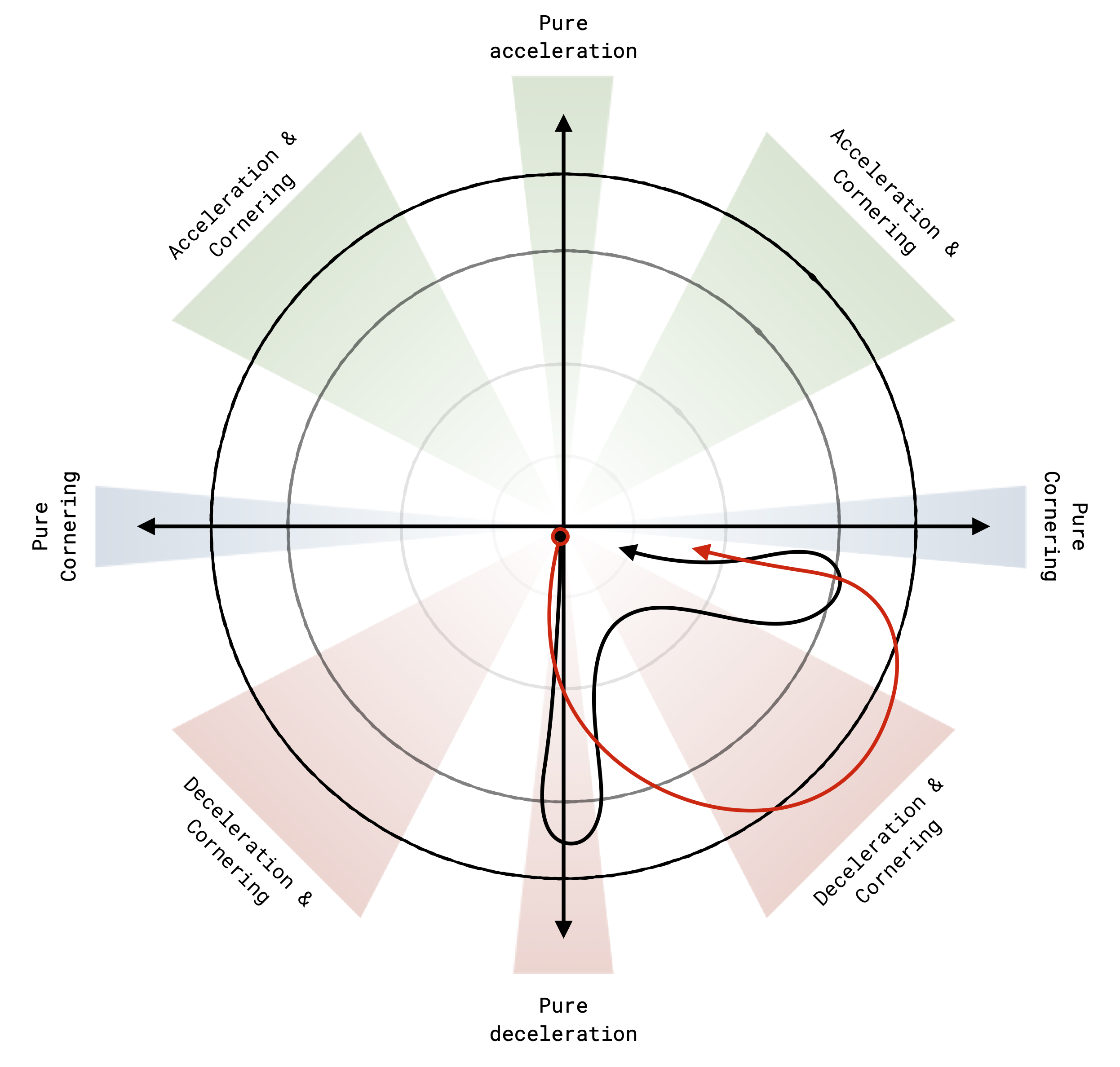
On the following gg diagram (yes, some imagination is required), the two different cornering maneuvers of two hypothetical riders are represented. While approaching the corner, the two riders have constant velocity, hence they are in the middle of the diagram. While approaching the corner the ‘black arrow rider’ brakes and turns with two very distinct actions: first a strong deceleration heading South in our wind rose is measured, second a strong lateral acceleration heading East is measured. The cloud of points in the gg diagram takes the typical ✝️ shape. While approaching the corner the ‘red arrow rider’ starts braking and cornering at the same time: a first deceleration heading South progressively heads SE, then E and finally the center of the diagram again. The resulting shape looks like a 🦋 wing or a 👂 lobe.
Comparing two cornering strategies on the gg diagram.
Typically, the less experienced riders are those who are not willing to brake and lean into the corner at the same time, hence they display a ✝️ in the gg diagram (at least, this is the lesson from motor sports…). Experts are those able to explore large portions of the gg diagram, and they can draw a nice 🦋. Can disk brakes help the riders feeling more stable and therefore complete the corners with a different strategy? This is still a speculation. I leave here some food for thoughts.
Soon I was on the climb, breathing through my ears as I fought the undulating ascent towards my first finish line. As I sprinted over the top, the video game came to life as I attacked the descent not as something to be survived, but as a race in itself. And it’s here that I must give due credit to the disc brakes. Until that descent, I have never experienced so much control over braking as I held the tires on the absolute limit of traction.
— Chad Haga, after winning ITT stage 21st, Giro d'Italia, June 2019
Competitive advantages
It is difficult to estimate the contribution that bike handling can have on cycling performance. Difficult, but not impossible to some extent. As you might acknowledge, bike handling assessment requires information about the accelerations, and they are never easily retrieved. With some degree of accuracy, accelerations might be estimated with GPS (even better option is to use GPS + IMU + a Kalman’s filter). Estimated accelerations can provide insightful recommendations.
Also, mathematical modelling is an extremely useful tool when it comes to simulate race data. Recently, I used a mathematical model to simulate a race with technical section: a 5-km section with 15-m radius hairpins interspersed with 400 m of straight road, downhill at 5%. Simulations revealed that the same virtual rider could loose 1’03” in 5-km on a wet VS a dry road. Road conditions were simulated by changing the friction coefficient from 0.9 (dry) to 0.36 (wet). In wet conditions, maximal lateral accelerations are much lower, hence the maximal cornering speed is also lower. This is just to prove the point that riders who can sustain larger accelerations might actually gain a tangible competitive advantage on the same terrain.
⏱️ Roughly we estimated that every 10% of improvement in bike handling could result in 13” gain down a 5-km technical section.
Following the simulation study, we set out to process experimental data collected on professional cyclists during an individual time trial with considerable technical content (see this link). The gg diagram was assessed for 27 riders in total.
☁️ We estimated that a 10% bigger cloud in the gg diagram was associated with 20 positions in the final rank.
Yes, of course, you’d better take these number and indications with a pinch of salt! They might be provide indications and they are not absolutes. However, something is better than nothing, right?
Conclusions and final thoughts
Whilst bike handling can be defined in multiple ways, I tried to converge to a single and well defined cycling ability. Ultimately, I define bike handling as the ability to consciously explore large portions of the gg diagram.
Most of the notions and terminology I used in this post might result poorly accurate for an expert in vehicle dynamics. I didn’t want to oversimplify concepts and terms, I just tried to keep only what I thought it was necessary. Even thou bicycles have been introduced 200 years ago, interaction between bike and rider is still a challenging research topic.
This blog is the result of few years spent studying cycling trajectories. I got the privilege to collaborate with great minds in the field of sports science and vehicle dynamics, and we eventually got to publish few scientific papers on the topic. I have been inspired by great athletes, who were ready to put everything on the line when the road became steeper.
These blog posts have been a great source of inspiration:
]]>Andrea Zignoliandrea.zignoli@unitn.itOxynet: A collective intelligence approach to cardiopulmonary test interpretation2021-05-27T00:00:00-07:002021-05-27T00:00:00-07:00https://andreazignoli.github.io/blog-post-1Photo by Ricardo Gomez Angel on Unsplash
This blog post was originally first published on LinkedIn.
Can researchers in AI-medicine help delivering more equitable and accessible healthcare services?
Some challenges transcend both time and geographical boundaries, and providing people with universal access to good quality health & care services is one of them. With strained healthcare systems and ageing populations, the world requires coordinated and systemic actions to provide timely and efficient diagnostics. As reported in the Orientations Towards the First Strategic Plan for Horizon Europe:
It is a main priority for the EU to support Member States in ensuring that health care systems are effective, efficient, equitable, accessible, and resilient while remaining fiscally sustainable in the medium and long term.
It’s pretty apparent that the EU community longs for solutions for the digital transformation of the healthcare system that could extend the reach of the high-level medicine outside the boundaries of the most developed countries. Emerging technologies in the field of AI-medicine can offer big opportunities to stimulate innovation and develop solutions in a wide variety of fields.
What is AI-medicine in cardiopulmonary exercise testing?
Cardiopulmonary exercising testing (CPET) is used worldwide to assess the responses of an individual’s cardiovascular and ventilatory systems to a known increasing working load. The results can be interpreted as a reflection on the general physical condition of the test patient and can be used to diagnose a number of cardiovascular diseases (e.g. coronary artery (ischemic heart)) and assess patient prognosis after a heart attack.
The main limitations that hinder the applicability of the CPET to a global scale are: A) it’s time-consuming and it must be conducted in a well-controlled environment; B) interpreting the results requires a high-level expertise and it might become subjective in some case.
On a scale much smaller than what has been seen in cardiology and dermatology, AI technologies such as machine learning and deep learning have been applied to CPET interpretation. This was done in the attempt to reduce variability of the interpretations across different experts and centres, and to ultimately help reducing the costs associated with current evaluation errors and delays.
In general, we can define AI in CPET interpretation as the use of algorithms and software to approximate human cognition in the analysis of CPET data.
The purpose of the Oxynet project is to develop automatic interpreters of cardiopulmonary exercising tests (CPET). To this, Oxynet wants to become a tool for a quick and encompassing diagnosis of medical conditions with CPET and promote accurate and timely clinical decisions.
Innovative aspects of Oxynet
Oxynet project was inspired by other bigger projects such as ImageNet and WordNet. It is based on a collective intelligence emerging from a network of internationally recognized experts in the field of CPET. The concept is very easy: a number of already interpreted CPET files are collected in datasets and they are used to train a deep neural network for the interpretation of new unseen files.
Collective intelligence explained
At the time of writing, Oxynet can support experts on a particular subclass of problems related to CPET interpretation: the ventilatory thresholds detection. The current AI algorithm is trained everyday with the data available on the servers.
This means that the ability of the AI in estimating ventilatory thresholds from CPET can improve day-after-day.
The accuracy of the Oxynet deep learning algorithm has been evaluated against the interpretation of independent and impartial experts. Results are encouraging, and indicate the possibility to use the algorithm in parallel with visual data inspection to speed up the interpretation of a CPET. Compared to other available computerised methods, Oxynet is more flexible, it doesn’t need any data pre-process and it’s poorly affected by noisy data. However, it’s the ability to integrate experts’ opinions that sets Oxynet apart from the other existing methods for automatic ventilatory thresholds detection.
Collaborative efforts
The use of AI-medicine techniques in automatic CPET interpretation raises a number of ethical questions regarding the reporting of standards for automatic methods vs experts. Admittedly, it is impossible to eliminate all the issues around subjective CPET data interpretation at once, and this is an ongoing process that will take time to take place.
Will we ever get to a point where the effects of the noise will be cancelled out and the interpretation obtained by aggregating all the different opinions will be as good as the opinions of the most-skilled persons in the group? Hopefully, yes …
An idiosyncratic noise is associated with each individual evaluation but taking the average over a large number of evaluations will likely get us closer to the ground-truth.
This phenomenon, is known as the wisdom of the crowd effect, and it’s about being able to sift out the noise of the individual interpretations to get closer to the ground truth.
Conclusions
There are two big limitations to the applicability of new AI-medicine algorithms: data availability and cross-expert communication. Oxynet has been conceived to facilitate both data sharing and experts exchange of knowledge. The constant increase of the internet usage worldwide is evident, and CPET data availability will likely increase in parallel. These trends suggest that this initiative will find fertile ground where to grow, and that international collaborative efforts will be needed to keep growing together.
Considering the structure, the results and the growing rate, Oxynet can be considered the first working example of a collective intelligence created to automatically interpret a CPET. It has been conceived to leverage internet ubiquity to deliver human-level CPET data interpretation ability everywhere in the world.
Contacts and acknowledgements
If you are interested to the Oxynet project, visit Oxynet website, send an email to oxynetcpetinterpreter(at)gmail.com or connect with me on Twitter, ResearchGate, etc.
This project would have never been possible (or at least it would have been much different) without the help of Filippo Degasperi, who kindly supported Oxynet with the “Restitution 2019” action. Appreciation and gratitude is also expressed to the Fondazione Cassa di Risparmio di Trento e Rovereto for supporting Oxynet and the involved researchers.
]]>Andrea Zignoliandrea.zignoli@unitn.itThe Greatest Show on Earth2020-03-22T00:00:00-07:002020-03-22T00:00:00-07:00https://andreazignoli.github.io/https:/hiitscience.com/blog-post-2In this post, I discuss how AI techonologies might assist us to monitor and optimize the chronic physiological adaptations that occur with endurance training, as well as how AI models might be used subsequently to develop more data-driven and systematic approaches to training program design.
In particular my discussion will be divided into two main sections: independency and intelligence (of a virtual coach).
]]>Andrea Zignoliandrea.zignoli@unitn.itHow AI is (not) going to change sport science2019-01-11T00:00:00-08:002019-01-11T00:00:00-08:00https://andreazignoli.github.io/https:/hiitscience.com/blog-post-3In this blog post with this (for some) controversial title, I diuscss why I don’t believe that we need AI to become better coaches or better sport scientists. Indeed, we need AI to test old ideas, and form new ones, to stimulate debate, and move our optimization forward.
AI, like all technologies, can be used, abused and misused. However, as with each technology or tool, it brings us the chance to test our convictions and change our positions. It aids us to refine the scientific process.
So, back to the question: “Do we need AI to be better coaches or sport scientists?” My answer today would be: “No, I don’t think so”. We didn’t need electric guitars to make better music, and we definitely don’t need AI to become better coaches or sport scientists. BUT, we needed electric guitars to create new sounds, stimulate new ideas, evolve new melodies and make songs for the new generations. AI as applied to coaching and sport science will be similar.